
The Argos sleep report 2026
Britain talks a big game about sleep: we know we need it, we plan our evenings around getting it, we buy the £40 pillow that promised to change everything. And yet only 38% of us would actually call our sleep "good." The rest of the nation is somewhere between "fine, I guess" and wide awake at 3am; mentally repainting the kitchen.
So what's really keeping the UK up at night? Who's getting the best rest? Who's drawing the short straw? And which corner of the country has quietly cracked the code on a good night's sleep? We surveyed 2,000 UK adults on their sleep habits, bedroom set-ups and biggest bugbears, and paired it with a city-by-city sleep environment index, to build the most complete picture yet of how Britain actually sleeps.
Fair warning: some of what we found might keep you up at night.
Key findings
- Only 38% of Brits report getting a good night's sleep, with women suffering far more than men due to higher stress levels and snoring partners.
- Bedroom heat is the UK's number one sleep disruptor, affecting over half of adults, and just over a quarter of us never change our bedding setup between seasons.
- Aberdeen tops our UK city sleep-environment ranking, while Watford comes last, held back mainly by the highest traffic congestion in the country.
- Despite living in the UK's second-worst sleep environment on paper, Londoners report the nation's highest sleep quality by actively compensating with newer mattresses and urban fixes.
- Younger generations are abandoning complete silence at bedtime, with over half of Gen Z relying on ambient audio, white noise apps, and late-night scrolling to drift off.
How Britain sleeps
We asked 2,000 UK adults to rate their sleep over the past month, and the picture isn't pretty. More than a third (38%) rate their sleep as "Good" or "Excellent." The rest of the country sits somewhere between "Average" and actively struggling: a quarter of Brits call their sleep "Poor" or "Very Poor."
Gen Z sleep better than Millennials and Boomers
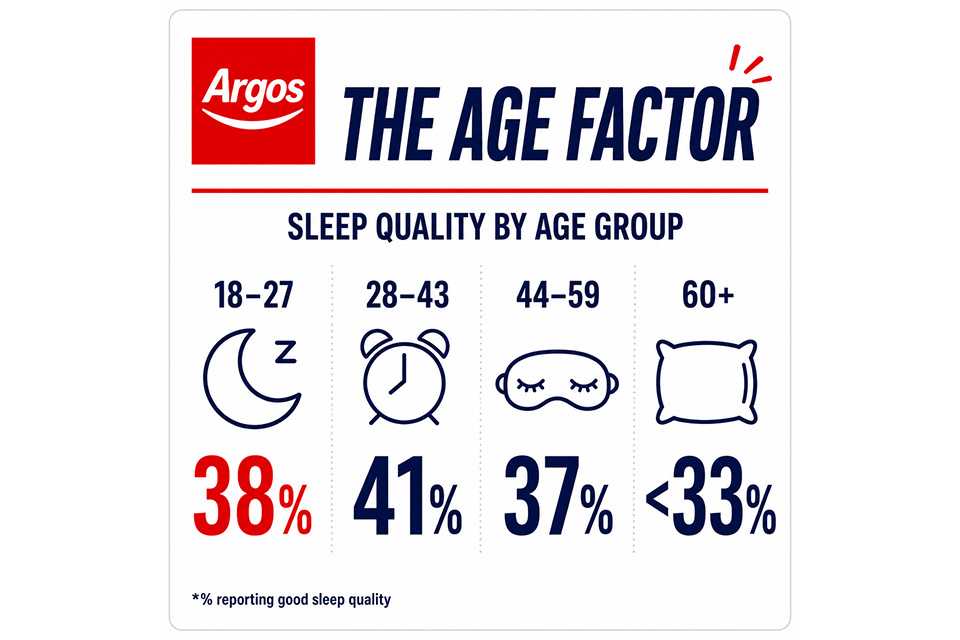
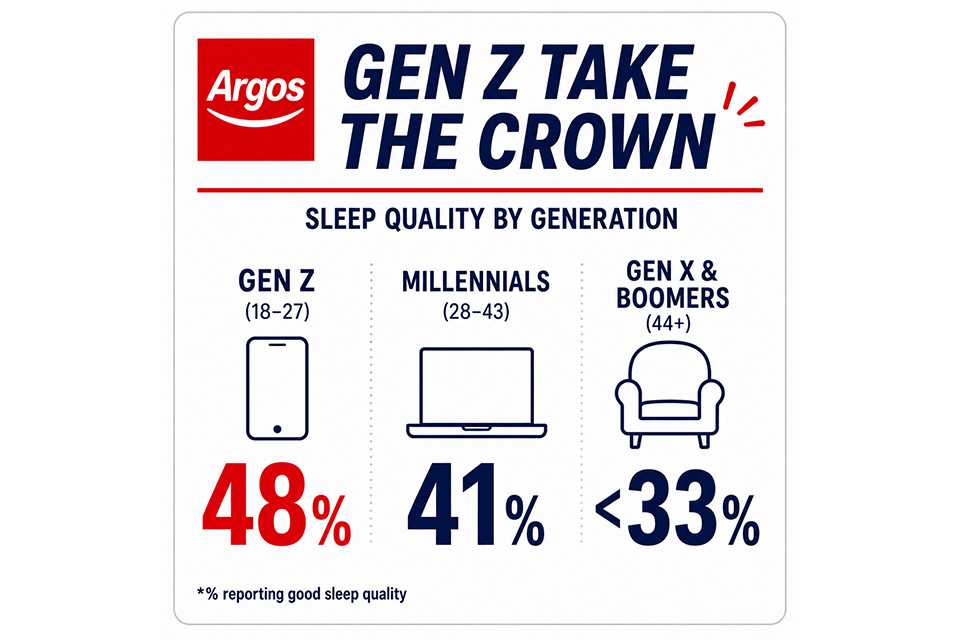
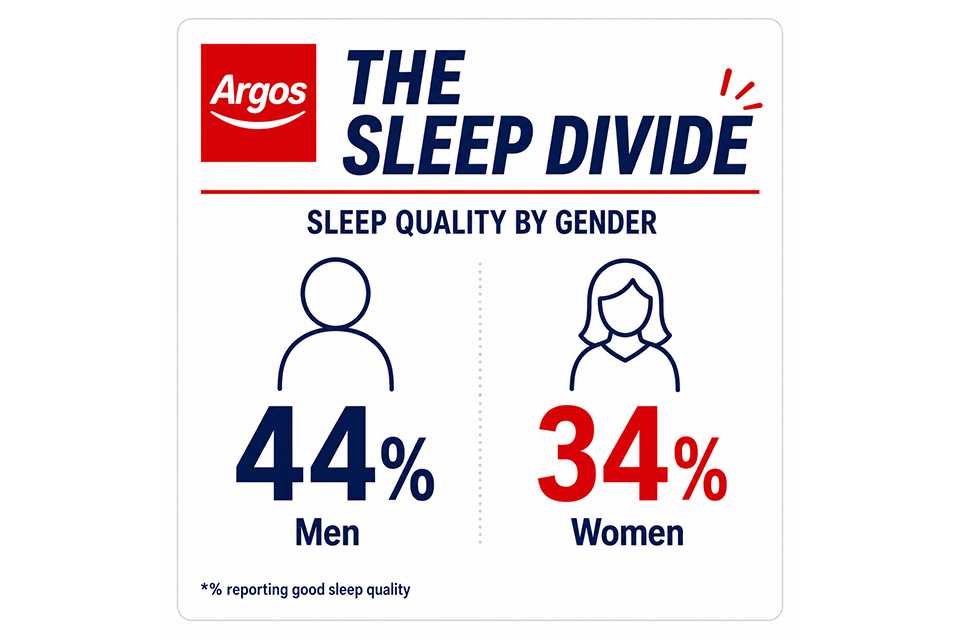
Sleep quality splits sharply by both age and gender. Men are noticeably more likely to report good sleep than women (44% vs 34%), and the generational gap is even wider. Nearly half of Gen Z rate their sleep as good, compared to under a third of Gen X and Boomers alike.
The gender gap
Dig into what's driving that gap between men and women's sleep quality, and stress is the biggest reason why. Over a third of women (34.6%) say stress, work or money worries disrupt their sleep, compared to about a quarter of men (26.9%). Women are also nearly twice as likely as men to be kept awake by a partner's snoring or restlessness (25.8% vs 14.9%).
The night shift
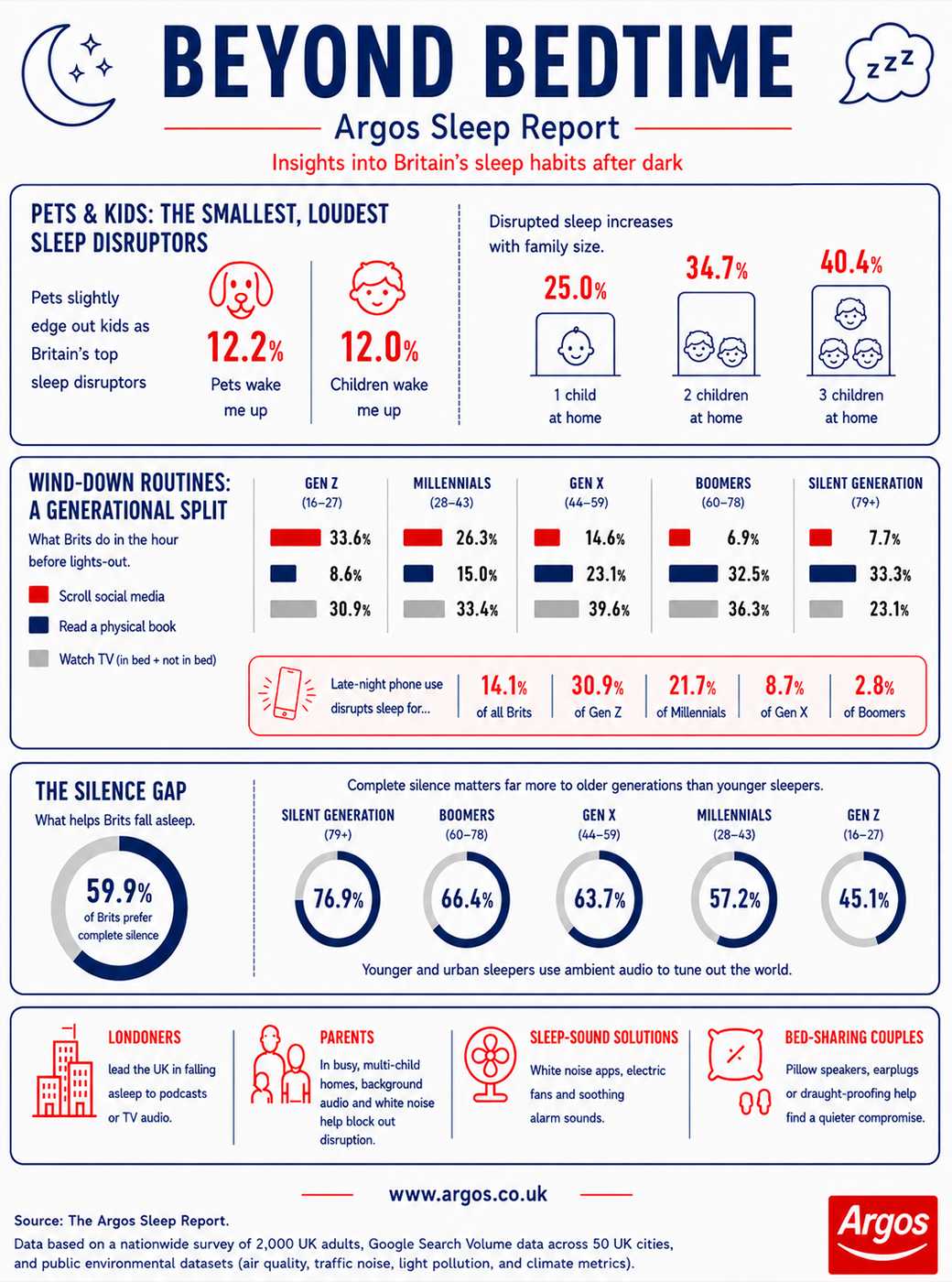
For parents, disrupted sleep isn't down to phones or snoring alone; it's a smaller, louder culprit altogether. Disrupted sleep increases with family size. Among parents with one child at home, a quarter (25%) say their child waking them up is a regular sleep disruptor, climbing to just over a third with two kids (34.7%) and two in five with three (40.4%). Fair to say, the night shift never really clocks off.
Yet children aren't the only ones keeping the nation awake. Nationally, pets have nudged ahead of kids as a sleep disruptor, waking up 12.2% of UK adults compared to 12.0% for children. So next time the dog decides 5 am is prime playtime, at least you know you're in good company.
Wind-down routines: a generational split
How Britain spends the hour before lights-out splits down generational lines. A third of Gen Z are scrolling social media in that final hour (33.6%), compared to under one in ten Boomers (6.9%), who are far more likely to be winding down with a physical book instead (32.5%, similarly high among the Silent Generation). Women lean into reading more than men, with over a quarter of women (25.3%) opting for a book before bed compared to just 17.1% of men.
That scrolling habit has a knock-on effect. Nationally, roughly one in seven Brits say late-night phone use directly disrupts their sleep, rising to almost a third of Gen Z.
The silence gap
How Britain drifts off to sleep reveals a clear generational divide in what we want to hear when the lights go out. While six in ten UK adults prefer complete silence, that figure drops sharply among younger sleepers who actively rely on ambient audio. A quiet room is non-negotiable for over three-quarters of the Silent Generation, but fewer than half of Gen Z need complete silence to fall asleep. Instead, younger sleepers frequently drift off to background TV shows, podcasts, or masking sound, such as white noise apps and electric cooling fans, to ease the transition into rest.
Living environments and household stress drive these acoustic habits as well. Londoners lead the country in falling asleep to podcasts or TV audio, using ambient sound to mask capital city traffic and street noise. Similarly, parents in busy, multi-child homes rely heavily on white noise and background media to block out household disruptions. Whether using an electric fan for steady humming or setting a digital alarm with soothing sleep sounds, younger and urban sleepers treat bedtime audio as an active sleep aid. For bed-sharing couples with mismatched sound preferences, soft contoured pillow speakers, earplugs, or draught-proofing offer an easy compromise without disturbing a partner who needs total quiet.
How long does a mattress last?
The average UK mattress is 5.9 years old, but that average hides a real generational divide. Gen Z tend to replace theirs roughly every four years, while Boomers hold on for closer to seven, with 10% keeping theirs for 15 years or more and 5.9% sleeping on a mattress over two decades old. It's widely recommended that you replace your mattress every seven to eight years. Yet across the whole country, roughly one in five adults are sleeping on one that's nine years old or more.
It's not just about comfort, either: a mattress that's had its day can leave you waking up worse than you went to bed.
Lauren Bennett, Senior Buyer for Beds & Mattresses at Argos, shares four signs it's time to swap your mattress:
- You wake up stiffer than when you went to bed. If the ache eases off within the hour of getting up and moving, that's a sign it's your mattress, not your body.
- It looks or sounds worn out. A sag in the middle, a squeak every time you roll over, a cover that's gone thin or stained in patches, these are all your mattress telling you it's past its job. They're easy to shrug off, but they usually mean the support underneath gave up a while ago.
- You sleep better away from home. A hotel bed, the spare room, even the sofa: it's tempting to put that down to a change of scenery, but more often than not, it's your own mattress letting you down.
- You genuinely can't remember how long you've had it. Most mattresses are built to last around seven to eight years, so if you're having to guess, there's a good chance you're already past it.
"A mattress's lifespan really comes down to three things: how well it's made, how it's looked after, and how much it's used. These days, plenty of us aren't just sleeping in bed; we're working from it, watching TV in it, scrolling in it, and all of that adds up to far more wear than a mattress in a guest room ever sees. Small habits, like rotating it regularly or using a protector, can add real years to how long it performs. Investing in a mattress topper is one of the simplest ways to help extend the life of a mattress, even more basic toppers can make a difference to the lifespan of your mattress – not to mention it makes them easier to clean and keeps your mattress fresher.
Once a mattress starts to go, it's not just about comfort anymore. You'll notice it in how well you sleep, how stiff you feel getting up, and for a lot of people, in aches in the back or neck they never think to blame on the bed. Sort it out, though, and it's one of the easiest wins there is: you'll feel the difference that night, and the next day too."
- Lauren Bennett, Senior Buyer for Beds & Mattresses at Argos
Where in the UK is best set up for a good night's sleep?
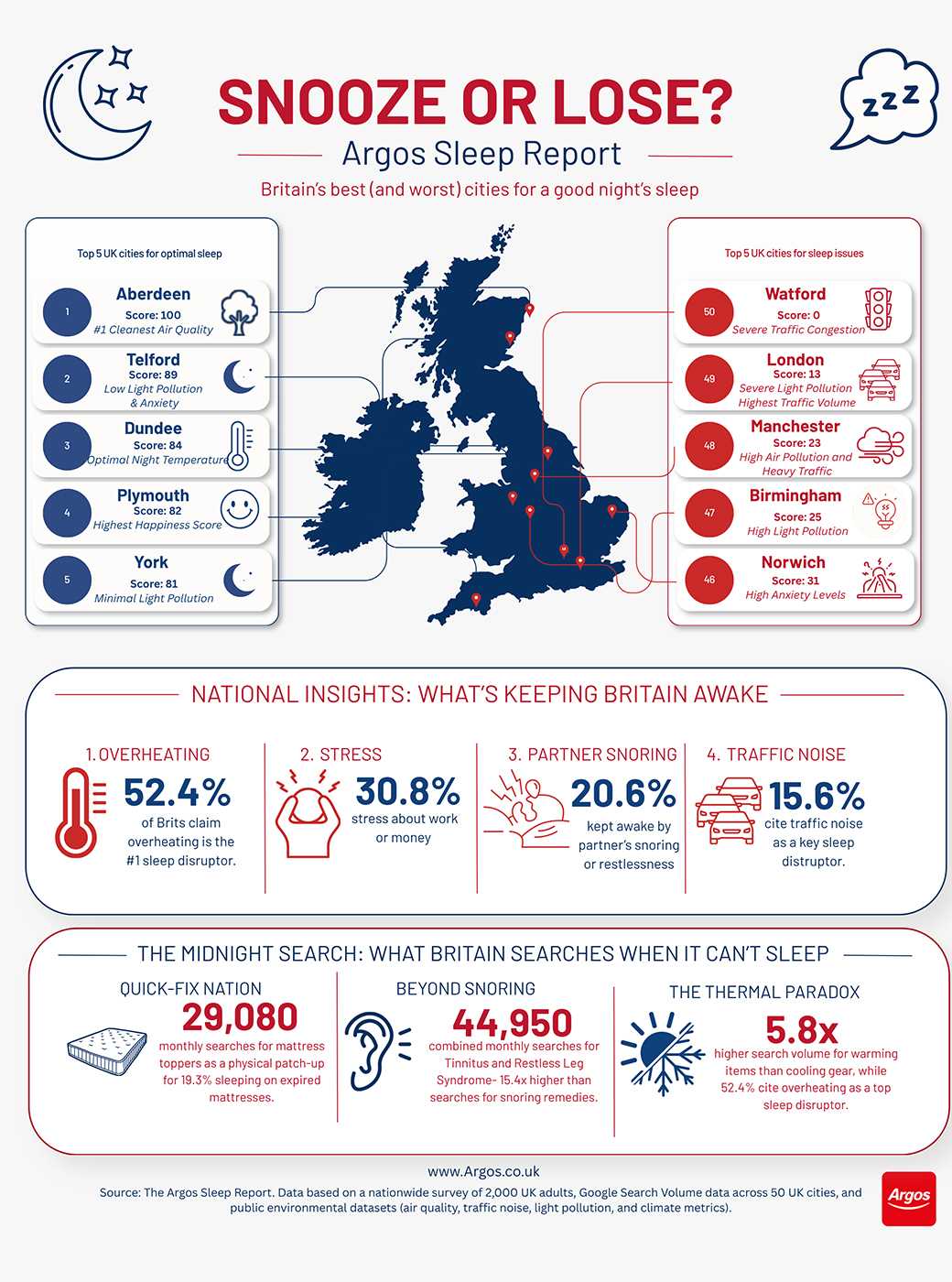
Where you live shapes how well you sleep too. We scored the top 50 most populated towns and cities in the United Kingdom across five environmental factors: light pollution, air quality, psychological wellbeing, traffic noise, and climate (night temperature and humidity), to find out where Britain sleeps easiest, and where it doesn't.
Where to go for the best night’s sleep?
Aberdeen takes the top spot, thanks to cool night air (averaging 8.4°C) and low traffic and light disruption. Telford follows close behind in second, benefiting from low light pollution and low anxiety levels locally. Dundee lands in third with the coolest average night temperature of the whole top five (7.6°C). Plymouth rounds out the top four, and stands out for a different reason: it has the highest happiness score of any city in the entire index. York completes the top five with strong dark skies and low light pollution of its own.
Top 10 cities best set up for a good night’s sleep
| City | Score / 100 | Key driver |
|---|---|---|
Aberdeen | 100 | Cool night air and very low traffic and light disruption |
Telford | 89 | Low light pollution and low local anxiety levels |
Dundee | 84 | Coolest average night temperature in the top five |
Plymouth | 82 | Highest happiness score of any city in the index |
York | 81 | Strong dark skies and low light pollution |
Edinburgh | 79 | Strong air quality |
Luton | 77 | Low anxiety and high happiness levels |
Swindon | 74 | Minimal light pollution |
Reading | 73 | Very low traffic congestion |
Swansea | 71 | Low light pollution |
The struggle zones
At the other end of the table, Watford comes last overall, driven largely by the highest per capita traffic congestion in the country by some distance. London isn't far ahead in second to last, weighed down by the highest traffic volume in the index and the worst air quality score. Manchester, Birmingham and Norwich round out the rest of the bottom five, each held back mainly by heavy traffic and elevated air pollution.
Top 10 cities least set up for a good night's sleep
| City | Score / 100 | Key driver |
|---|---|---|
Watford | 0 | Highest per capita traffic congestion in the country |
London | 13 | Highest traffic volume and worst air quality score |
Manchester | 23 | Heavy traffic and elevated air pollution |
Birmingham | 25 | Heavy traffic and elevated air pollution |
Norwich | 31 | Heavy traffic and elevated air pollution |
Southampton | 38 | High anxiety and low happiness levels |
Leeds | 38 | Elevated light pollution |
Northampton | 41 | Poor climate conditions (temperature and humidity) |
Portsmouth | 42 | Poor air quality |
Liverpool | 44 | Elevated light pollution |
The London sleep paradox
Here's where it gets interesting. London ranks near the very bottom of our sleep index, yet Londoners report the best sleep quality of any UK region: more than half (54%) rate their sleep as good or excellent, well above the national average of 38.6%, and far ahead of the South West, which reports the lowest regional sleep quality in the country (28.6%). London also has the youngest average mattress of any region (4.9 years, versus 6.9 in the South East). So the capital has the worst sleep environment on paper, but some of the best-rested residents in the country. Environmental factors, as it turns out, aren't the whole story.
Searching for a solution
Online search demand tells a vivid, real-time story of Britain's nightly struggle. Manchester emerges as the nation's sleepless capital, topping per-capita queries for "insomnia” at nearly twice the rate of London. It's not a one-off either: Manchester also leads the country in per-capita searches for blackout curtains, electric blankets, eye masks and earplugs. Plagued by heavy urban traffic and air pollution near the bottom of our sleep index, Mancunians aren't just lying awake, but are actively hunting for a way out.
This search behaviour reveals a clear national pattern: whatever the environmental trigger, Brits reach for immediate comfort fixes. Across the dataset, mattress topper queries dominate all product searches, generating nearly six times the volume of specialised temperature fixes like a cooling mattress or cooling pillow options. When the local environment works against a good night's rest, Britain's first instinct is simply to build a softer, warmer, and darker sleep haven.
What's keeping Britain awake?
Some nights it's the heat. Some nights it's a snoring partner. Some nights it's the phone, glowing away at midnight with "just one more scroll." We asked Britain what disrupts sleep most, and one culprit came out well ahead of the rest.
Just over half of Brits (52.4%) say bedroom heat or overheating is their biggest sleep disruptor, easily the top answer nationally. Stress, work or money worries follow in second (30.8%), then a partner's snoring or restlessness (20.6%), excess light (18.4%) and traffic noise (15.6%).
The overheating epidemic
Despite bedroom heat topping the list of national sleep disruptors, over a quarter of Brits never adapt their setup between seasons, sticking with the same duvet and bedding year-round. That habit is worst among Gen X, where nearly a third refuse to swap things up as the weather changes. Trapping body heat under a heavy winter setup in summer triggers constant tossing and turning, keeping your core temperature too high for deep REM sleep.
Roughly a third of Brits switch bedding materials seasonally. Natural, moisture-wicking fabrics like linen, percale and 100% crisp cotton promote airflow and prevent heat retention far better than dense synthetic materials. Selecting the correct bed linen can make all the difference in a good night’s sleep.
Bedside battles
For the vast majority of Brits who share a bed or bedroom, daily compromises come with the territory. Snoring is the most common tension point (26.5%), followed closely by duvet stealing and rows over bedroom temperature: one person too hot, the other too cold. Separately, just under a third of adults don't share a bed or bedroom at all, whether that's living alone or otherwise.
You don’t need a full “sleep divorce” to get a good night’s sleep, though. Here are four practical fixes for your bedtime dramas:
- The Scandinavian duvet method: Swap one shared cover for two single duvets on a double or king bed. This eliminates duvet stealing and lets partners choose individual bedding warmth levels (e.g. a heavier duvet for colder winter nights.)
- Dual-zone heating: Try a dual-control electric blanket or split-tog duvet to settle temperature arguments without heating the whole room.
- Anti-snore support: Snoring disrupts over a quarter of shared beds, with women nearly twice as likely as men to be woken up. Swapping to an ergonomic memory foam pillow helps align the head to keep airways clear.
- Motion isolation: A pocket spring or high-density memory foam mattress absorbs movement locally, preventing a restless partner from waking you up.
The cooling tech generation gap
Younger Brits are reaching for tech to solve the heat problem; older Brits are reaching for the window latch. Around one in five Gen Z use a cooling mattress or topper to manage bedroom temperature, compared to under 5% of Boomers. Meanwhile, open windows are the go-to fix for around seven in ten Millennials, Gen X and Boomers, but only just over half of Gen Z.
The unlikely suspect
Turns out it's not just the snoring next to you, it's what's going on inside your own head. More Brits Google "nightmares" than "snoring" nationally, more than double, despite snoring being one of the most commonly reported sleep disruptors in our own survey.
This psychological disruption concentrates heavily in major urban centres and northern regions. Scotland emerges as the UK's bad dream capital, led by Dundee, where searches for nightmares outpace snoring by seven to one. On a per-capita basis, Glasgow and Manchester lead the entire nation in searches for bad dreams, proving that for millions of sleepers, internal stress poses a bigger barrier to rest than a noisy bed partner.
Search behaviour has another tell too: whatever's actually wrong, most people reach for the same fix. Mattress topper is the most-searched sleep product in the whole dataset, nearly six times the combined volume of cooling mattresses and cooling pillows. When in doubt, Britain just wants a comfier bed.
A quick checklist for a cooler, quieter bedroom
Lauren Bennett, Senior Buyer for Beds & Mattresses at Argos breaks down four easy fixes for a cooler, quieter night's sleep:
- Swap bedding seasonally. Most bedrooms run the same setup all year round, and that's usually the problem. If heat's your problem, a lighter tog duvet or a cooling topper does more than an extra fan. If it's the cold, an electric blanket will do the trick. Picking the right duvet and pillow combination will ensure you’re on your way to a good night’s sleep.
- Block the light out properly. Blackout curtains or blinds make a bigger difference than most people expect, especially once early summer mornings start creeping in before you are ready to be awake. Even a sliver of light through the curtains is enough to nudge a body clock off course.
- Give noise-sensitive sleepers an out. Not everyone needs total silence, but for the ones who do, white noise, a fan, or a properly draught-proofed window can settle a restless room without a full renovation.
- Don't let clutter creep into the bedroom. A laundry pile in the corner or a desk doubling as a dumping ground keeps the mind half-working even after the lights go off. A stressed-out space makes for a stressed-out night.
The £500 sleep fix
Given a £500 bedroom budget, Britain bypasses smart gadgets and luxury trends to address fundamental comfort. A new mattress clear-cut tops the national wish list (22.2%), easily outpacing high-quality bedding (16.3%) and storage furniture (12.7%). Given the choice, the nation overwhelmingly rejects flashy décor in favor of replacing core essentials.
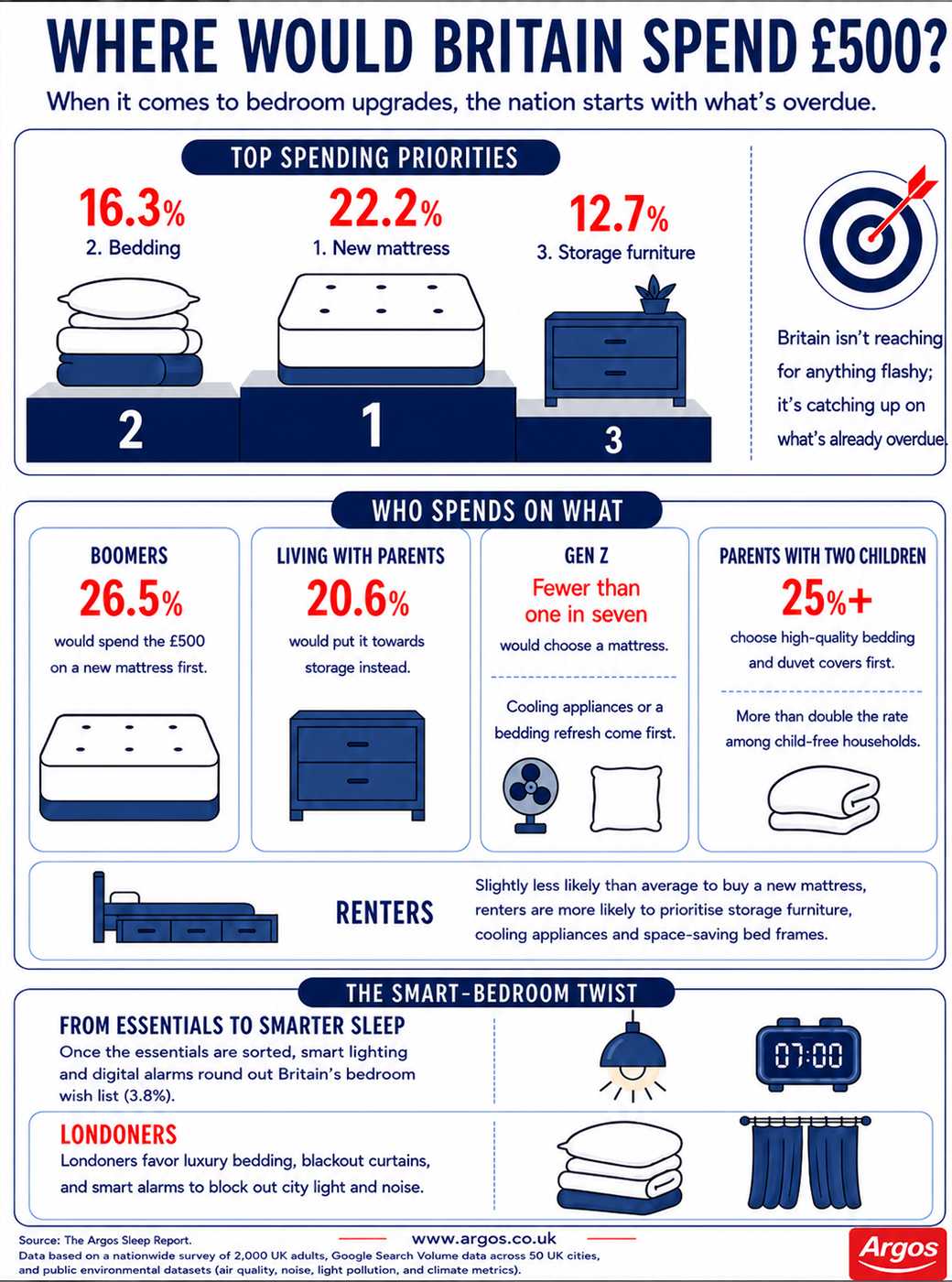
That instinct holds across the board, just pointed at different things depending on what's actually broken. Boomers, who we already know hold onto mattresses the longest, are also the most likely to put the money there first (26.5%). Anyone still living with parents skips the mattress question entirely and goes straight for storage instead (20.6%), because more space, not a better bed, is their actual problem.
And if you were expecting a smart-tech twist to close this out, here's one: smart lighting and digital alarms round out the list. Once the essentials are sorted, it seems Britain's next move is making the bedroom a little smarter.
Who spends on what
Generational priorities set the sharpest divide of all. While Boomers invest in core support, Gen Z flips that hierarchy entirely: fewer than one in seven would put their £500 towards a mattress, choosing portable cooling appliances or a bedding refresh instead. For younger sleepers battling nighttime heat, staying cool wins out over buying a new bed.
Housing and family life shift the picture too. Renters overall are only slightly less likely than the national average to spend on a new mattress (18.9% vs 22.2%), though those renting via agencies or living with parents pivot heavily toward storage furniture, cooling appliances, and space-saving bed frames to maximize tight layouts. Parents take a different route, reaching for quick comfort: over a quarter of those with two children choose high-quality bedding and duvet covers first, more than double the rate among child-free households. When free time is short, an easy refresh beats a bigger purchase.
Geography adds its own twist. Londoners, despite living with one of the country's worst urban sleep environments, favour luxury bedding over a new mattress. With some of the UK's youngest mattresses already in place, their spending goes instead toward targeted urban fixes, like thermal blackout curtains and smart wake-up alarms, to shut out streetlights and city noise.
Methodology
The Sleep Report 2026 is built on a nationally representative survey of 2,000 UK adults, conducted in August 2026, with quotas on age, gender and region. We asked people about everything from sleep quality and mattress habits to sleep disruptors, bedroom environment, noise preferences and spending priorities, to find out what's really getting between Britain and a good night's sleep.
To evaluate where in the UK is best set up for a good night's rest, we scored the 50 most populated towns and cities across five core environmental metrics, standardizing all data points using min-max normalization and applying an equal 20% weight to each category to calculate a final Sleep Environment Score out of 100. Psychological wellbeing (20% weight) was benchmarked using ONS Personal Wellbeing datasets by local authority, combining local happiness scores with inverse anxiety ratings. Climate and night temperature (20% weight) drew from Met Office historic weather station averages and Copernicus ERA5 climate data, awarding higher scores to cooler nighttime temperatures and optimal relative humidity. Light pollution (20% weight) utilized NASA VIIRS satellite imagery and CPRE Night Blight maps to measure artificial nighttime radiance, favoring lower sky brightness. Traffic noise and congestion (20% weight) combined DEFRA Strategic Noise Mapping, TomTom Traffic Index data, and Department for Transport statistics to evaluate per-capita vehicle volume and ambient decibel exposure, scoring quieter urban areas higher. Finally, air quality (20% weight) relied on DEFRA UK-AIR monitoring datasets tracking particulate matter (PM2.5 and PM10) and Nitrogen Dioxide (NO2) concentrations, rewarding cities with lower ambient pollution.
Alongside that, we looked at real search data for sleep-related terms across the same towns and cities, adjusted for population size, to get a clearer picture of where people are actively searching for a better night's sleep.
Data correct as of August 2026.
Frequently asked questions about sleep
How often should you replace your mattress and bedding?
A mattress should generally be replaced every seven to eight years to maintain proper support. In fact, our own survey found that roughly one in five UK adults are currently sleeping on a mattress that's nine years old or more. Pillows should generally be replaced every 1 to 2 years, while items like a duvet or mattress topper typically last between 3 to 5 years depending on material quality and care.
Should you buy a mattress topper or replace your mattress entirely?
Buy a mattress topper if your bed is structurally sound but needs extra cushioning or cooling, but replace the entire mattress if you notice sagging, squeaking, or wake up with spinal stiffness.
What duvet tog is best for preventing nighttime overheating throughout the year?
Choose a 4.5 tog duvet for warm summer months, a 9.0 to 10.5 tog for spring and autumn, and a 13.5 tog for cold winter nights.
What is the UK’s primary sleep disruptor?
Bedroom heat and overheating are the UK’s primary sleep disruptors, affecting just over half of adults. Despite this, just over a quarter of Brits use the same bedding setup year-round.
Do blackout curtains actually improve sleep quality in cities?
Yes, blackout curtains block ambient urban light, streetlight glare and early summer sun, preventing light from suppressing melatonin production and disrupting circadian rhythms. Excess light disturbs sleep for 18.4% of UK adults.