
Easy games for festive gatherings
Enjoy some festive fun this Christmas with a range of board games for all to enjoy.
Shop all board games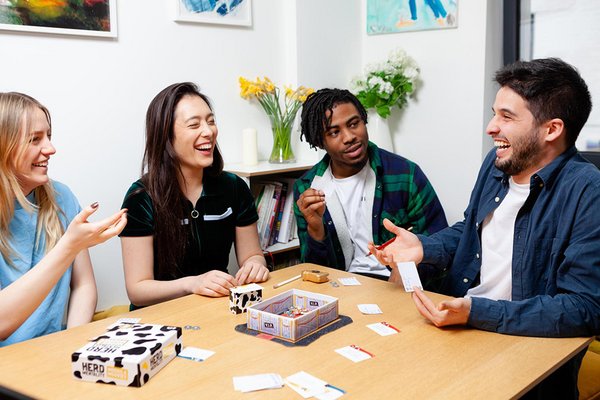&poi={$this.metadata.pointOfInterest.x},{$this.metadata.pointOfInterest.y},{$this.metadata.pointOfInterest.w},{$this.metadata.pointOfInterest.h}&scaleFit={$sfcenter}&sm=aspect&aspect=3:2&sfcenter=center&sfpoi=poi&qlt=50&fmt=auto&noiser=0&fmt.jpeg.interlaced=true&fmt.jp2.qlt=40&)
By Steven Smith | Date published: September 2026
Easy games for festive gatherings

Good food brings everyone to the table. A simple game can keep them there, even after the last roast potato has disappeared.
Whether you’re planning Christmas with the family, seeing in the New Year with friends or filling a quiet moment between courses, the right game can keep the fun going. We’ve rounded up easy card, board and action games that need little preparation and are simple to pick up.
Quick answer: which games work well for festive gatherings?
For festive gatherings, the best options are games that are quick to set up, easy to learn and fun to play for all ages. Card games are ideal when table space is limited. Word, quiz and guessing games can get bigger groups talking, while quick action games work well when you want a change of pace.
When choosing games for your Christmas get togethers, you’ll want to think about the following things:
- The recommended age of the game
- The minimum and maximum number of players
- How long a round usually takes
- How much space you need to set up the game
- If the content is suitable for the group
A mix of one quick game and one longer group game should give you options without turning your gathering into a full tournament. Unless everyone wants one, of course.
How to choose an easy party game
The best choice depends on who is coming and when you plan to play. A relaxed card game may suit the quieter part of the evening, while a lively guessing or action game can bring everyone together after dinner.
Think about your group
With board games ranging from 1 or 2 player suitability through to needing larger groups, and varying maximum player counts, consider the size of your group.
If adults and children are playing together, look for a family game with straightforward rules and content that’s suitable for the youngest player. Check the age guidance on the box rather than assuming a familiar game will suit everyone.
Keep the rules easy to explain
Opt for a game that doesn’t need a lot of discussion to understand. A party game shouldn’t need a long introduction. Choose a game where you can explain the core gameplay in the shortest possible way.
If the rules are new to everyone, try reading them before your guests arrive. You can then get the first round moving without asking the whole room to wait.
Match the game to the moment
Different games suit different parts of a gathering:
- Guests are arriving: choose a short, simple game that people can join between rounds to keep guests entertained.
- Everyone is around the table: try cards, word games or compact board games.
- After dinner: bring out a quiz, guessing or team game.
- Energy is starting to dip: switch to a quick action or reaction game.
- You have a mixed group: pick a game with simple turns and flexible team play.
Check the space you have for games
Some games feature a large board and multiple pieces so a large, clear table or similar surface might be needed. Others only need a hand of cards, or nothing at all. Think about where you’ll be playing games and how much space you can offer when choosing your games.
Read our board games guide for more inspiration.
Quick card games for easy entertainment
Card games are great when you want something compact, portable and quick to start playing. They also work well if guests arrive at different times because many games can be played in short rounds.
Matching and shedding card games
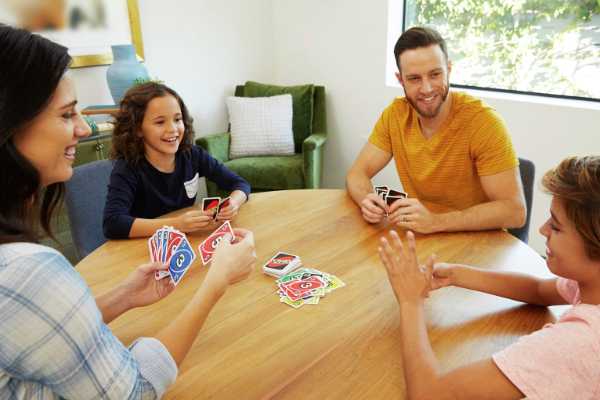
Matching games usually give each player the same simple aim: play or remove cards by following a colour, symbol or instruction. Classic options such as UNO can be easy to pick up because turns move quickly and the main play pattern is straightforward.
Different versions may introduce extra cards or more challenging rules, so check the exact edition before playing. Versions such as UNO Show ’Em No Mercy may suit groups looking for a more competitive game, but its age guidance and rules should be checked first.

Prompt-based card games
Prompt and response games can help adult groups get talking. Players normally choose or respond to cards, so there is little physical set-up.
Check the age rating and content carefully. Some card games, including Cards Against Humanity, are intended for adults, though they do have a family friendly version.
Traditional playing cards
A standard pack of cards gives you plenty of choice without taking up much room. Choose a game your group already knows or print a short set of rules in advance for one simple option.
Group games that get people talking
Word, quiz and guessing games are a good fit when the main aim is to bring guests together. They can also work for larger groups when players divide into teams.
Description and guessing games
Games such as Articulate ask players to communicate words or ideas under a time limit. This style of game can create plenty of conversation because people take turns describing, guessing or acting.
For larger gatherings, team play helps more people join in. Keep teams reasonably balanced and swap the person giving clues so everyone gets a turn.
Majority and opinion games
Herd Mentality is based around giving answers and trying to think like the wider group. This type of party game can work well when guests have different levels of gaming experience because the focus is on shared responses rather than specialist knowledge.
Opinion-based games are also useful for breaking the ice. Remind players to keep answers friendly and suitable for the group.
Quiz games
Trivial Pursuit and other quiz games suit groups that enjoy testing their general knowledge. They can be played individually or in teams, depending on the edition and the number of guests.
Mixed teams can help balance different interests and knowledge. It also means nobody has to face the difficult questions alone.
Social deduction games
Games inspired by hidden roles, secret information or elimination can create a longer group activity. A game based on The Traitors may appeal to guests who enjoy discussion, bluffing and working out who to trust.
These games can involve more explanation than a quick card game, so they may suit the main event rather than a spare ten minutes.
Fast-paced games for a change of energy
Not every festive game needs a board or a score sheet. Reaction and dexterity games can bring a quick burst of activity when people have been sitting around the table.
Reaction games
Electronic reaction games such as Bop It usually give players spoken or sound-based prompts to follow. They use little floor or table space and can be played in quick turns.
Check whether the volume will be suitable for the room and consider whether every guest can follow and respond to the prompts comfortably. A quieter table game may be a better alternative for some groups.
Two-player games with a queue
Games such as Connect 4 are designed around two people playing at once, but they can still work at a gathering. Set up a simple winner-stays-on format or let people play while waiting for food, drinks or another activity.
This approach works best as an extra option rather than the only game available, particularly when you have a large group.
Television-inspired games
Games based on familiar programmes, such as Deal or No Deal, can make the format easier to recognise. They may also give your gathering a theme without needing decorations or extra preparation.
Word games for the table
Word games can be a good middle ground between a lively party game and a quiet board game. They often have compact pieces and can be played in rounds.
Bananagrams
Bananagrams uses letter tiles to create connected words. Players build their own arrangement, so everyone can focus on their tiles at the same time.
It is worth making sure each player understands the word rules before starting. For a more relaxed gathering, you can play without putting too much focus on speed.
Boggle
Boggle challenges players to find words from a shared set of letters. Everyone looks at the same letter grid and writes down the words they spot within the round.
Make sure players have paper and pens before you begin. If you have a large group, smaller teams may make it easier for everyone to see the letters.
Other compact word games
Look for word games with short rounds, limited pieces and a clear scoring system. These are practical when you have a small table or want something that can be packed away quickly before the next course.
A family gathering may include young children, teenagers and adults, so one game will not always suit everyone. The age rating, reading level and type of play are more useful than simply choosing a box labelled “family game”.
For a mixed-age group there are a few things you’ll want to think about:
- Choose rules that can be explained with an example turn
- Avoid relying entirely on reading speed or specialist knowledge
- Use teams if this helps younger players join in
- Keep rounds short enough for people to take breaks
- Offer a quieter alternative
- Check that the content is suitable for the youngest player
A family quiz, simple matching game, guessing game or familiar tabletop game can be a good place to start. If younger children lose interest, avoid pressuring them to continue. Another guest can take their turn, or the group can move on to a shorter game.
Games to play in a small room
You don’t need a large space to play festive games. Focus on activities that keep players seated or use a small area of the table.
Good options when space is limited can include:
- Compact card games
- Word and letter games
- Quiz games
- Verbal guessing games
- Small two-player games
- Team games without physical challenges
Clear away anything fragile before you begin and keep walkways free. Avoid active races or throwing games indoors, particularly when space is limited.
If the group is too large for one table, create two smaller game areas and let people swap after each round. This can be more relaxed than trying to fit everyone around one board.
Simple hosting tips for a festive games’ night
A little planning can help the games feel like part of the gathering rather than another task on your list.
Choose games before guests arrive
Pick two or three options and leave the rest in the cupboard. Too much choice can slow things down.
When planning games that will work for everyone, try to include:
- One quick card or reaction game
- One group game
- One quieter option
Read the instructions ahead of time
Open new games and check the contents before the gathering. Read the rules and make sure any batteries, pens, paper, timers or scoring pieces are ready.
Let people opt in
Not everyone likes competitive games or being put on the spot. Invite guests to join without making it compulsory. Team play, scorekeeping or simply watching can offer other ways to take part.
Keep the competition friendly
Agree any house rules before starting and avoid changing them halfway through. If there is a disagreement, check the instructions or make one clear decision so the game can continue.
Know when to finish
A short game that ends while everyone is still enjoying it is better than one that continues for too long. Choose formats with natural stopping points, especially if food or other activities are planned.
FAQs about easy festive games
What are some easy games for a Christmas party?
Easy Christmas party games include card games, quiz games, word games and team guessing games. Look for an option with short set-up, rules that can be explained clearly and a player range that matches your group. Card games can work well around a busy table, while team games such as quizzes or description games can involve more guests. Check the recommended age and content before playing, especially when children and adults are joining the same game.
How do you choose a game for a family gathering?
Start with the ages and number of people who may want to play. Then consider how much time and space you have. For a mixed-age family group, choose a game with simple turns and limited specialist knowledge. Teams can make quiz or guessing games more inclusive, while matching and compact board games may suit smaller groups. Always check the age recommendation and player information for the exact edition, as these can differ between versions of the same game.
What games work well for a large group?
Team quizzes, description games, guessing games and majority-style games can work well for large groups because several people can take part at the same time. Divide guests into manageable teams so everyone has a chance to contribute. Avoid games with long gaps between turns, as players may lose interest while waiting. Before choosing, check the maximum player number in the instructions. Some games support team play even when the number of individual pieces or counters is limited.
What games can you play in a small room?
Card games, compact word games, quizzes and verbal guessing games are practical choices for a small room. They need little floor space and can usually be played while everyone remains seated. A small two-player game can also be set up as an extra activity, with guests taking turns between rounds. Keep walkways clear and avoid indoor games that involve running, throwing objects or moving quickly around furniture. If the table is crowded, choose a game with few loose pieces.
Which party games are quick to set up?
Card games, reaction games and compact word games are often quick to set up because they use a limited number of components. Some can begin as soon as the cards, tiles or electronic unit are ready. However, the rules may still take time to learn, so read them before guests arrive. Check whether the game needs batteries, paper, pens or a timer. Having these ready means, you can move straight into an example turn rather than stopping to find missing items.
Can children and adults play party games together?
Children and adults can play together when the game’s age recommendation, content and difficulty suit the youngest person taking part. Matching games, simple quizzes and team guessing games can be easier to adapt for mixed ages. Pairing younger and older players may help but make sure everyone still has an opportunity to contribute. Do not rely only on a “family” description. Check the packaging and instructions for age guidance, reading requirements and any content that may not be suitable for children.
How many games do you need for a festive gathering?
Two or three options are usually enough for a gathering. Choose one quick game, one main group game and, if useful, a quieter alternative. You may not play all of them, but the small selection gives you flexibility if the number of guests or mood changes. Too many choices can make it harder to get started. Set out the game you are most likely to play and keep the others nearby, along with any batteries, pens, paper or timers they need.